
More Than 3000 Years of Moroccan History
The study of Moroccan dynasties history reveals one of the oldest continuous political and cultural traditions in North Africa. Archaeological discoveries at sites such as Jebel Irhoud show human presence in Morocco dating back hundreds of thousands of years. Organized societies later emerged through Amazigh kingdoms, Phoenician trade networks, Roman influence, and Islamic states. Morocco’s political history as a kingdom extends for more than twelve centuries, while the cultural roots of its populations go back over 3000 years.
Morocco was originally inhabited by Amazigh populations, often called Berbers in older historical literature. The term “Amazigh” means “free people.” Long before the arrival of Arab dynasties or Islamic expansion, Amazigh tribes organized political systems, trade routes, and agricultural societies across the Atlas Mountains, the Sahara, and Mediterranean regions. Academic research on the medieval Maghrib identifies the Almoravids, Almohads, Marinids, and several later dynasties as indigenous Amazigh powers that shaped Morocco and much of western Islamic civilization.
Unlike many regions where dynasties disappeared entirely, Morocco preserved a continuous monarchy through successive ruling houses. Each dynasty transformed cities, architecture, trade systems, and political institutions. The imperial cities of Fes, Marrakech, Meknes, and Rabat still reflect the ambitions of these ruling families.
The Idrisid Dynasty and the Birth of the Moroccan State
Moroccan Dynasties History and the Foundation of Fes
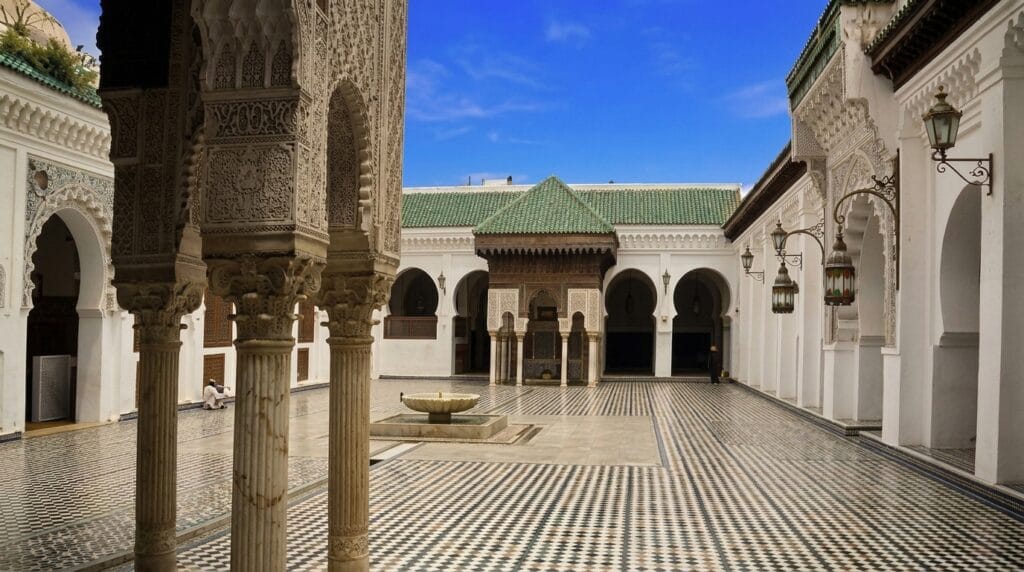
The Idrisid dynasty marked the beginning of the first Moroccan Islamic state. Idris I, born around 745 CE, founded the dynasty in 788 CE after fleeing Abbasid persecution in the Middle East. He established authority among Amazigh tribes in northern Morocco and created the foundations of a centralized kingdom.
His son, Idris II, born in 791 CE, expanded the kingdom and founded the city of Fes in 808 CE. Fes quickly became an intellectual, religious, and commercial center. Its position near caravan and agricultural networks allowed the city to grow into one of the most important capitals in the Islamic West.
The Idrisids ruled approximately from 788 to 974 CE. During this period, Morocco developed independent political institutions distinct from Abbasid control. The dynasty also encouraged the migration of scholars, craftsmen, and merchants from Al-Andalus and Ifriqiya. These movements shaped the urban and cultural identity of Fes.
The city became famous for the University of Al Quaraouiyine, founded in 859 CE by Fatima al-Fihri. Historians often describe it as one of the oldest continuously operating universities in the world. The intellectual role of Fes emerged directly from Idrisid political stability and urban planning.
The Almoravid Dynasty: Amazigh Expansion and the Foundation of Marrakech
Moroccan Dynasties History and the Rise of Marrakech
The Almoravid dynasty emerged during the 11th century among Sanhaja Amazigh tribes in the Sahara and southern Morocco. The dynasty began as a religious and political reform movement before transforming into a major empire extending across Morocco and Al-Andalus. Academic studies describe the Almoravids as one of the first major Amazigh imperial powers in western Islamic history.
Yusuf Ibn Tashfin, born around 1009 CE, became the most important Almoravid ruler. In 1070 CE, the Almoravids founded Marrakech as their capital. The city’s location near Atlas trade routes allowed control over trans-Saharan commerce linking gold, salt, and textiles.
The Almoravids ruled from approximately 1040 to 1147 CE. During this period, they unified large parts of Morocco and crossed into Iberia to confront Christian kingdoms. Their victory at the Battle of Sagrajas in 1086 temporarily slowed Christian expansion in Al-Andalus.
Marrakech became the symbol of Almoravid authority. The dynasty developed irrigation systems, mosques, markets, and defensive walls. The city also gave Morocco its international name in many European languages, derived from “Marrakesh.”
Architecturally, the Almoravids expanded the use of rammed earth construction, geometric decoration, and monumental urban planning. They reinforced the role of Marrakech as a commercial capital linking Europe, sub-Saharan Africa, and the Mediterranean.
The Almohad Dynasty and the Imperial Transformation of Morocco
Moroccan Dynasties History and the Almohad Revolution
The Almohad dynasty emerged in the 12th century among Masmuda Amazigh tribes of the High Atlas Mountains. Ibn Tumart, born around 1080 CE, founded the ideological basis of the movement. After his death, Abd al-Mu’min transformed the movement into a vast empire stretching from Libya to Spain.
The Almohads ruled from approximately 1121 to 1269 CE. Historians consider them one of the most powerful medieval Islamic empires. Their administration centralized political authority more strongly than previous dynasties.
The Almohads transformed several imperial cities. In Marrakech, they expanded palaces, mosques, and fortifications. They also developed Rabat as an imperial project. Sultan Yaqub al-Mansur, born around 1160 CE, ordered the construction of the Hassan Tower around 1195 CE. The unfinished mosque complex reflected the dynasty’s ambition to create one of the largest Islamic monuments in the western Mediterranean.
The Almohads also built:
- the Koutoubia Mosque in Marrakech
- the Giralda in Seville
- major fortifications across Morocco
Their architecture emphasized symmetry, monumental proportions, and refined geometric decoration.
Economically, the Almohads controlled Mediterranean and Atlantic trade routes. Their navy became one of the strongest in the medieval western Mediterranean. Their currency circulated widely across Europe and North Africa.
The Marinid Dynasty and the Intellectual Age of Fes
Moroccan Dynasties History and the Marinid Cultural Renaissance
The Marinids, another Amazigh Zenata dynasty, rose to power after the decline of the Almohads. They ruled Morocco approximately from 1244 to 1465 CE.
Abu Yahya ibn Abd al-Haqq, born in the early 13th century, helped establish Marinid political control. However, Sultan Abu al-Hasan Ali, born around 1297 CE, became one of the dynasty’s most powerful rulers.
The Marinids chose Fes as their capital and transformed it into the intellectual center of Morocco. They built madrasas, mosques, fountains, and caravanserais throughout the city.
Among the most important Marinid constructions:
- Bou Inania Madrasa
- Al-Attarine Madrasa
- city fortifications
- royal gardens
Marinid architecture became famous for extremely refined decoration in:
- cedar wood
- zellij tilework
- carved stucco
Academic studies identify the Marinid period as one of the high points of western Islamic decorative arts.
The Marinids also attempted to preserve Muslim territories in Iberia by supporting Granada against Castilian expansion. However, internal divisions and external pressure gradually weakened the dynasty.
The Wattasid Dynasty and the Portuguese Pressure
Moroccan Dynasties History During Political Fragmentation
The Wattasids, a branch of the Marinids, ruled Morocco approximately from 1472 to 1554 CE. Their period coincided with major geopolitical transformations, including Portuguese expansion along the Atlantic coast.
Unlike previous dynasties, the Wattasids struggled to centralize authority. Portuguese forces occupied several coastal cities including:
- Asilah
- Safi
- Azemmour
This period weakened Moroccan trade networks and political cohesion.
Despite these challenges, Fes remained an important intellectual and religious center.
The Saadian Dynasty and the Battle of the Three Kings
Moroccan Dynasties History and the Saadian Golden Age
The Saadian dynasty ruled Morocco approximately from 1549 to 1659 CE. The dynasty claimed Sharifian descent from the Prophet Muhammad and emerged during resistance against Portuguese expansion.
Sultan Ahmed al-Mansur, born in 1549 CE, became the most famous Saadian ruler. His reign followed the Battle of Oued al-Makhazin in 1578, also called the Battle of the Three Kings. Morocco defeated the Portuguese army, preserving its independence while much of North Africa came under Ottoman or European domination.
The Saadians made Marrakech their capital once again. Ahmed al-Mansur constructed:
- El Badi Palace
- royal gardens
- monumental ceremonial spaces
The palace reflected influences from Andalusian, Ottoman, and sub-Saharan artistic traditions.
The Saadian period also expanded trade with West Africa. Gold from the Sudan region financed architecture, diplomacy, and military campaigns.
The famous Saadian Tombs date from this dynasty and remain among Morocco’s major historical monuments.
The Alaouite Dynasty and Modern Morocco
Moroccan Dynasties History and the Modern Moroccan State
The Alaouite dynasty began in the 17th century and still rules Morocco today. The dynasty officially emerged around 1631 CE and unified Morocco under Sultan Moulay Rashid in 1666 CE.
Moulay Ismail, born around 1645 CE, became one of Morocco’s most influential rulers. He transformed Meknes into an imperial capital during the late 17th century.
Meknes reflected military and administrative power. Moulay Ismail constructed:
- massive defensive walls
- monumental gates
- royal granaries
- stables
- water reservoirs
The city symbolized centralized royal authority and military organization.
The Alaouites later developed Rabat as the modern political capital. During the 20th century, the dynasty played a central role in negotiations leading to Moroccan independence from French and Spanish colonial control in 1956.
Today, the Alaouite monarchy remains one of the oldest continuous ruling dynasties in the world.
Jewish Mellahs and Royal Protection in Imperial Cities
Moroccan Dynasties History and the Mellah System
One unique aspect of Moroccan urban history involves the creation of mellahs, or Jewish quarters, near royal palaces in imperial cities.
In cities such as:
- Fes
- Marrakech
- Meknes
mellahs often developed close to centers of royal authority. Historians explain this organization partly through the desire to keep Jewish communities under direct royal protection. Jewish merchants, diplomats, and craftsmen played important economic roles within Moroccan society.
This urban arrangement reflected both political control and protection mechanisms inside imperial cities.
Amazigh Roots and Dynastic Continuity
The story of Moroccan dynasties history reflects continuity rather than rupture. From the Idrisids to the Alaouites, Morocco preserved political institutions, imperial cities, and cultural traditions across centuries of transformation.
Amazigh populations played a central role in shaping Morocco’s kingdoms, armies, architecture, and trade systems. Dynasties such as the Almoravids, Almohads, and Marinids emerged directly from Amazigh tribal confederations and built some of the most important cities and monuments in the Islamic West.
The imperial cities of Fes, Marrakech, Meknes, and Rabat remain living archives of this dynastic history. Their mosques, palaces, madrasas, and fortifications continue to illustrate how Morocco developed one of the richest historical landscapes in North Africa.